
Surry County Criminal Docket Searches
North Carolina Portal is the public starting point for a Surry criminal docket. Smart Search covers the whole state, so add the Surry County location filter after you type a record number or a last, first name. You can search anonymously. An account only adds a saved My Cases folder. Keep Portal separate from North Carolina File & Serve, which is the filing application rather than the public lookup. Criminal and infraction files both show up here. There is no search by charge name, though. A precise record number works best. A name search can pull up to 200 results, so narrow things down with location, case type, status, or a date-of-birth range. Portal hides the birth month and day in public results. If a match still seems unclear, give the Surry clerk the case number and category when you call.
image_after
- Open Portal Smart Search and complete the CAPTCHA if it appears.
- Enter a complete record number, or enter the person’s name last, first.
- Add Surry County, then select Criminal or Infraction when an advanced filter is useful.
- Open the returned case number to read its Case Summary, hearings, events, and disposition information.
- Use Search Hearings or the clerk when a current setting, public document, or certified copy needs confirmation.
Read a Surry Criminal Case Summary
Open a record in the Portal and you land on the Case Summary, sometimes titled a Register of Actions. It reads top to bottom. Case Information and Assignment Information tell you the case number, the court, and where it sits. Party Information lists who is involved. Case Events give the dated run of filings, orders, and settings. Hearing and disposition details follow, along with financial data when any exists, and public documents. One caution: an event entry records that something happened. It does not promise that every paper behind it is online for Surry County cases.
The state's own Portal training resources walk through the public search and the document functions. Surry County moved onto eCourts in July 2025. That makes Portal the working route for current case information statewide. Older paper records, though, may still rest with the clerk of court.
The Judicial Branch's county criminal disposition activity report is the official page behind this report.
County-level activity reporting gives you context for the criminal docket system. To examine one public case closely, the Case Summary is still the place to go.
Criminal Dockets: What They Show
Every Surry County criminal docket entry starts with the basics: the case number, the case type, the status, and the assignment. Under Portal's Enterprise Justice format, that case number has four parts. You get a two-digit year and case-type letters. Then come a six-digit sequence and a three-digit county identifier. The official guide offers 23IF000022-420 as a sample. Older calendar and paper material can carry a legacy-style number, so treat an unfamiliar format as a clue about age rather than a mismatch.
| Case Information | Record number, type, status, and basic case-level details. |
|---|---|
| Assignment Information | County and court assignment context for the matter. |
| Case Events | Dated process, filing, service, order, setting, and status entries where public. |
| Hearings | Scheduled hearing details; use Search Hearings for current location and time. |
| Dispositions | System outcome or status labels that must be read with the event history. |
| Financial Information | Case-level financial data only when the case has information in that section. |
Portal shows public documents one at a time rather than as a single packet. An empty financial panel proves only that nothing is displayed there, not that no amount was ever ordered. And a calendar line is just a date on a list, never a substitute for the full case record in a Surry County docket search.
Surry Criminal Docket Status Labels
The portal stamps each case with a system label instead of telling its story. Pending simply means no disposition has been entered yet. When you see Disposed or Completed, the label alone tells you little. Open the event list and read the disposition details before drawing any conclusion about what happened. Those two labels cover a lot of ground. The underlying entries do the real work.
Other labels you may run across in a Surry County criminal docket or infraction case include Archived, Remanded, Transferred to Superior Court, Appealed–Appellate, Voluntarily Dismissed with Leave, Pending Expungement, and Pending–Reported to DMV. Each one points you back to the case events for the full picture.
- Case event
- A dated docket action, such as process issuance, service, a filing, an order, or a setting.
- Disposition
- The recorded result or outcome section, distinct from the date a matter was merely heard.
- Continuance
- A court-authorized postponement. Confirm the next setting after it appears in the Case Summary.
- Trial de novo
- A new Superior Court trial after a criminal District Court appeal, not a review of the old transcript.
Note: A status label is only a shorthand tag on the Surry County court docket. Read it alongside the public case events before drawing any conclusion about what happened in the case.
Criminal Case Stages on the Docket
At the opening stage, note the record number, division, charge information, parties, and case status. Case Events come next. There you may see a summons, warrant, order for arrest, service return, lack of service, reset, or recall. The hearing record identifies a setting. In a Superior Court matter, the local calendar category adds session context. It does not announce the outcome.
Docket flow: Filing or process › Arraignment › Pretrial setting › Plea or trial › Disposition › Sentencing when applicable.
Once a hearing wraps up, check the event, hearing, and disposition sections of the docket against each other. A posted session calendar can lag behind the real setting. For the current time and place, Search Hearings beats the calendar, and the clerk can settle any conflict between the two.
Surry Criminal Docket Calendar Groups
Superior Criminal sessions fall into calendar categories. The Local Administrative Schedules on the Surry County criminal docket list them: Administrative, Attorney, Custody, Plea, Plea and Motions, and Trial. A Plea calendar handles plea matters. A Trial calendar means matters may be called for trial. No one is promised a fixed trial time. Administrative and attorney labels describe the session type only. The Case Summary is still the record that speaks to the specific case.
The Surry County local administrative schedules page lists those criminal calendar categories and links out to statewide calendar services. The North Carolina Recovery Courts page describes the program shown in the official material that follows.
The published recovery-court material shows how a program can carry its own court setting context. Even so, it does not create a separate public criminal docket database.
Surry County Criminal Docket Courts
Surry County handles criminal charges inside North Carolina's unified General Court of Justice. A single Clerk of Superior Court keeps the records. The split is simple. Felonies belong to Surry County Superior Court. Misdemeanors, infractions, traffic cases, and most early criminal proceedings stay in Surry County District Court. Both divisions sit in District 23. Every county case file moves through the Surry County Clerk of Superior Court and the Portal system.
A ticket written in Mount Airy, Elkin, Dobson, or Pilot Mountain does not set up its own city criminal docket. The ticket names the agency. The case itself runs through the state courts. When you need more detail than a citation gives, the Surry docket search page explains how to search by name or record number across public case types.
North Carolina's Adult Treatment Court page shows Surry listed in District 23.
That official listing confirms the local program exists. The underlying criminal case, though, stays in the unified Surry court system.
When Surry Criminal Dockets Need the Clerk
Portal has limits. A Surry County court docket pulled online can look thin. An older file may still be paper. A document may not be posted yet, or a restriction may limit what the public may see. The state does offer public self-service terminals at clerk offices. Those cover criminal, civil, special-proceeding, and estate searches. Visitors can also inspect a public paper file. Ask at the Surry clerk's counter during regular office hours.
Need a human? The Surry contact directory sends Criminal District and Criminal Superior questions through the clerk system at (336) 386-3700. Bring a case number or a name. Say which item you want. Certified copies cost extra. Ask the Surry clerk what certification or copy fees apply. Confirm the record is public first. The court posts no fixed Surry criminal copy rate or processing time.
North Carolina's expunction information explains how the state handles clearing eligible records.
An expunction can close off an eligible state record. So an empty Portal result is not proof a case never existed.
Access Rules for Criminal Dockets
North Carolina opens clerk-maintained dockets and indexes to public inspection unless a law says otherwise. In Surry County, Portal carries the publicly available entries. The clerk counter or public terminal stands in for any eligible public file. Sealed and confidential cases never appear there. Sealed documents and data stay out of Portal too. Juvenile records are withheld from public view unless a statute or court order allows it. Some protective-order information has controlled online access.
North Carolina access rules:
G.S. 7A-109 requires clerks to maintain court records, files, dockets, and indexes and opens them to inspection unless law says otherwise.
G.S. 132-1 defines public records and supports copies at minimal actual reproduction cost unless another law sets a charge.
G.S. 7B-3000 restricts public inspection of juvenile court records.
The juvenile-record confidentiality statute is the source represented by this image.
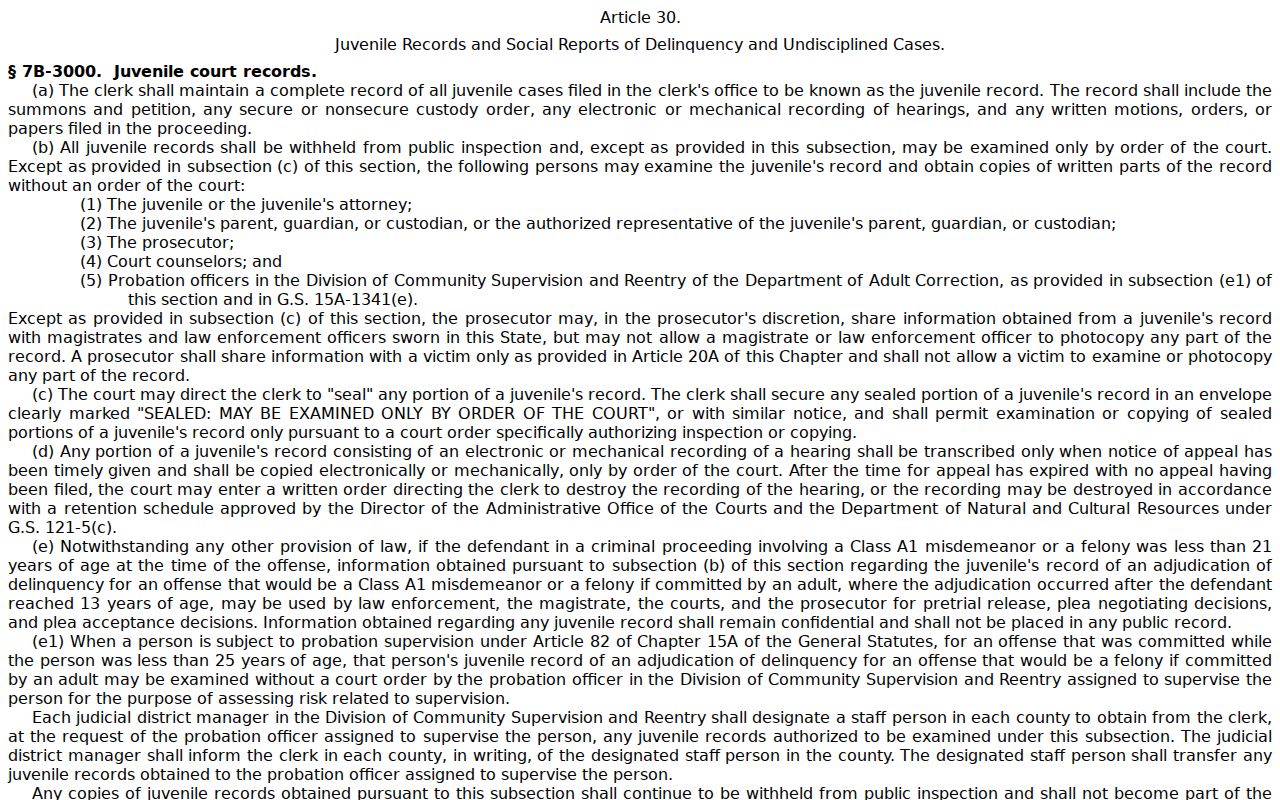
The access rule draws a boundary. It is not an invitation to work around protected files with some other search.
Surry Criminal Docket Treatment Court
Surry County runs an Adult Treatment Court through District 23. What it is: an intensive program, supervised by a judge, for participants who qualify. The state's material lists no special record-number system. It names no judge, posts no public calendar, and offers no Surry recovery-court portal of its own. That leaves a simple route for the public. Pull the underlying case number in Portal. Then ask the clerk about any public setting or record tied to it.
Treatment details and program participation can be restricted. Treat a recovery-court reference in a case file as limited court information rather than a window into private treatment. Note: the state source does not establish any separate public docket practice for the Surry program.